On January 1, 2026, the U.S. public domain expanded once again, and HathiTrust opened more than 78,000 volumes published in 1930 for full-view access. Although 1930 was marked by economic hardship in the wake of the 1929 stock market crash and the onset of the global Great Depression, it was a remarkably rich year for literature. Drawing on contemporary book reviews, we selected a small but diverse group of titles to highlight—ranging from novels (including the year’s bestseller and two enduring classics) to short fiction, history, autobiography, memoir, and a children’s story.
Laments For the Living by Dorothy Parker
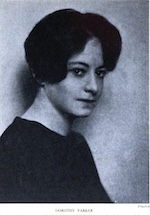 When Dorothy Parker (1893-1967) collected 13 of her previously published stories to create this volume of short fiction (her first), she was already famous for her literary criticism and poetry. Her book of poems Enough Rope, published in 1926, was a best seller and was quickly followed by Sunset Gun in 1928. One reviewer at the time called Parker’s first collection of stories “little gems of satire and of understanding” – and another wrote:
And as you reread them, and gasp again at the diabolic accuracy of her dialogue and her complete sense of pace and craftsmanship, I think you will agree that here is perhaps the greatest living master of ironic humor - humor in its fullest meaning of human comedy, the pathetic, thwarted, ridiculous struggle of ordinary mean mortals, with all their weariness and sour spite and tiny personal agonies. (Vanity Fair, August 1930).
The collection includes the story “Big Blonde” which won the O’Henry award in 1929 for best short story of the year.
As I Lay Dying by William Faulkner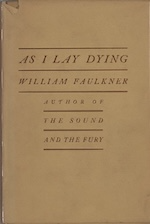 As I Lay Dying is considered to be among the best of Faulkner’s 13 novels, though the author claimed that he wrote it in just six weeks and without revision. The novel tells the harrowing tale of a southern family plagued by poverty, mental illness, and incest, whose matriarch dies early in the narrative. The story is told in the voices of the novel’s 15 characters using internal dialog and stream of consciousness. Reviews at the time were mixed. The Forum and Century called Mr. Faulkner a “daring and sometimes perverse” experimenter with a “kind of mad power in his writing.” The Nation wrote, “Despite the enthusiasm which has greeted Mr. Faulkner's work, it is difficult to believe him an important writer. His morbidity is interesting but tends to repeat itself.” The New Yorker called it “a novel you may wonder over,” and praised the story for being “keenly told.” Nineteen years after its publication, Faulkner won the 1949 Nobel Prize in Literature for his “powerful and artistically unique contribution to the modern American novel 1.”
The Tale of Little Pig Robinson by Beatrix Potter
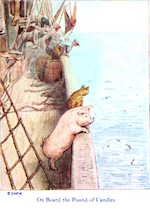 This self-illustrated chapter book tells the tale of a pig who is kidnapped and taken to sea by a ship’s cook, but manages to escape and have great adventures. The tale references two popular literary works: after his escape, Little Pig Robinson becomes a castaway, referred to as “Poor Pig Robinson Crusoe” (like Daniel Defoe’s Robinson Crusoe) in the “land where the bong-tree grows” (like the “Piggy-wig” in Edward Lear’s “The Owl and the Pussycat”).
Paul Robeson, Negro by Eslanda Goode Robeson
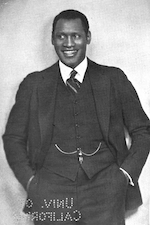 Paul Robeson (1898-1976) was a globally renowned actor, singer, athlete, lawyer, and civil rights activist. W.E.B. Du Bois called Robeson “without a doubt” the "best known American on earth" because "his voice is known in Europe, Asia and Africa, in the West Indies and South America and in the islands of the seas (page 3).” However, this biography was written long before politics halted his meteoric rise; Robeson, it turned out, was an unrepentant Marxist, socialist, and radical – traits that, in the era of McCarthy, upended his stunning career in politics and in Hollywood. The author – Robeson’s wife, agent and manager, Eslanda (Essie) Goode Robeson (1895-1965) – was herself an accomplished chemist, anthropologist, and human rights activist. In 1930, The Crisis deemed her biography of her husband to be among the “Books We Must Read”.
Armageddon; The World War in Literature edited by Eugene Löhrke
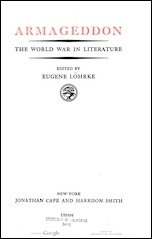 This anthology of writing about World War I, with first person accounts, stories, letters, poems, newspaper wires, speeches, song lyrics, and government proclamations, is anything but a dry history book. A reviewer at the time wrote that the editor “confined himself to books and shorter pieces that promise to endure.” A look at the table of contents confirms Löhrke’s ability to select durable authors: Edith Wharton, John Dos Passos, William Faulkner, Joseph Conrad, H.G. Wells, E.E.Cummings, P. N. Krasnov, and Maxim Gorky, among many. Starting with the assasination of Archduke Ferdinand and declarations of war, the anthology tells a gripping and roughly chronological tale. It does not end with the war’s conclusion, but continues with a chapter on “Revolution” with a focus on the new Soviet Union, and finishes with stories from the war’s “Aftermath.”
My Thirty Years War by Margaret Anderson
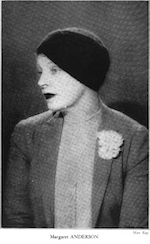 This is the first volume of a three-part autobiography by Margaret Anderson (1886-1973), the editor, publisher and founder of The Little Review, a ground-breaking avant-garde literary magazine published from 1914 to 1929. My Thirty Years War covers Anderson’s life from childhood to 1929, when the final edition of The Little Review was published. In this volume, Anderson recounts an incident, in 1921, in which she and her lover and editorial collaborator Jane Heap, were charged with and convicted of obscenity for serializing the opening chapters of James Joyce’s Ulysses. Anderson describes how a trial judge refused to allow the allegedly “obscene” passages to be read aloud in court in her presence - reflecting the common belief at the time that censorship was justified to protect the perceived innocence of children and young women. When her lawyer protested that she was the publisher, the judge replied, “I am sure she didn't know the significance of what she was publishing”! (page 265).
The Forty-Second Parallel, by John Dos Passos
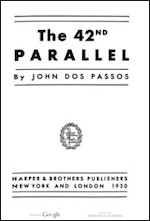 John Dos Passos (1896-1970) attended Harvard, drove an ambulance during WWI, and became immersed in the left-wing politics and causes of the 1920s. These politics are reflected in this novel, the first of his acclaimed U.S.A. Trilogy, which is written in an experimental style and includes four interwoven threads. According to critic George D. Snell, The 42nd Parallel “founded a new school in the American novel. Its highly original technique influenced a score of younger men (page 255).” While Dos Passos may not be considered to be as prominent today, in 1938, Jean Paul-Sartre declared him to be “the greatest writer of our time."
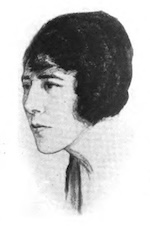 This sweeping Western about Manifest Destiny and the Oklahoma land runs of the late 1800’s was the best selling novel of 1930 and was quickly made into a critically acclaimed movie of the same title the following year. Ferber (1885-1968) had already achieved great success with the Pulitzer prize-winning novel, So Big, published in 1924. It was quickly followed by Show Boat (1926) which was turned into the popular musical in 1927. While Ferber described
as “a malevolent picture of what is known as American womanhood and American sentimentality” and intended it to be satirical, most readers took the book at face value (2). Sabra, the strong female protagonist, evolves from being a traditional housewife to a successful leader and politician, yet her beliefs remain prejudiced and rigid throughout. It is Sabra’s swashbuckling, open-minded-yet-unstable husband, Yancy, who embraces multiculturalism and diversity. The novel depicts the struggles of many characters who are considered outsiders, something Ferber herself experienced both as a Jew growing up in the Midwest and as a young woman attempting to build a career in a male-dominated profession.
Black Manhattan by James Weldon Johnson
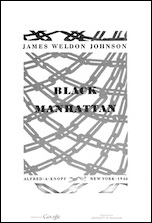 This “first full-length history" of Black people in New York, opens with the 1626 founding of New Amsterdam, when the Black population was just 11 residents (slightly more than 5% of the population at the time), and progresses through the Harlem Renaissance. Johnson (1871-1938) said one of his prime purposes was to write “a continuous record of the Negro's progress on the New York theatrical stage” (see Introduction) - which he does, while also representing much more. At the time, The Journal of Negro History lauded his book for its “valuable facts that have not as yet appeared in any other history,” and The Crisis featured it under “Books We Must Read,” noting that the first six chapters are historical but starting with chapter seven:
“...the tempo changes and James Weldon Johnson the poet… begins to speak with authority and throbbing interest of Harlem. Mr. Johnson is at his best in these chapters for a simple reason… He was a part of that first climax of Negro art in New York.” (page 313)
Notes
1 "Nobel Prize in Literature 1949: William Faulkner" The Nobel Prize, Nobel Foundation, n.d., https://www.nobelprize.org/prizes/literature/1949/faulkner/facts/.
2 Shapiro, Ann R. "Edna Ferber, Jewish American Feminist." Shofar: An Interdisciplinary Journal of Jewish Studies, University of Nebraska Press, Volume 20, Number 2, Winter 2002, https://muse.jhu.edu/pub/17/article/31473.